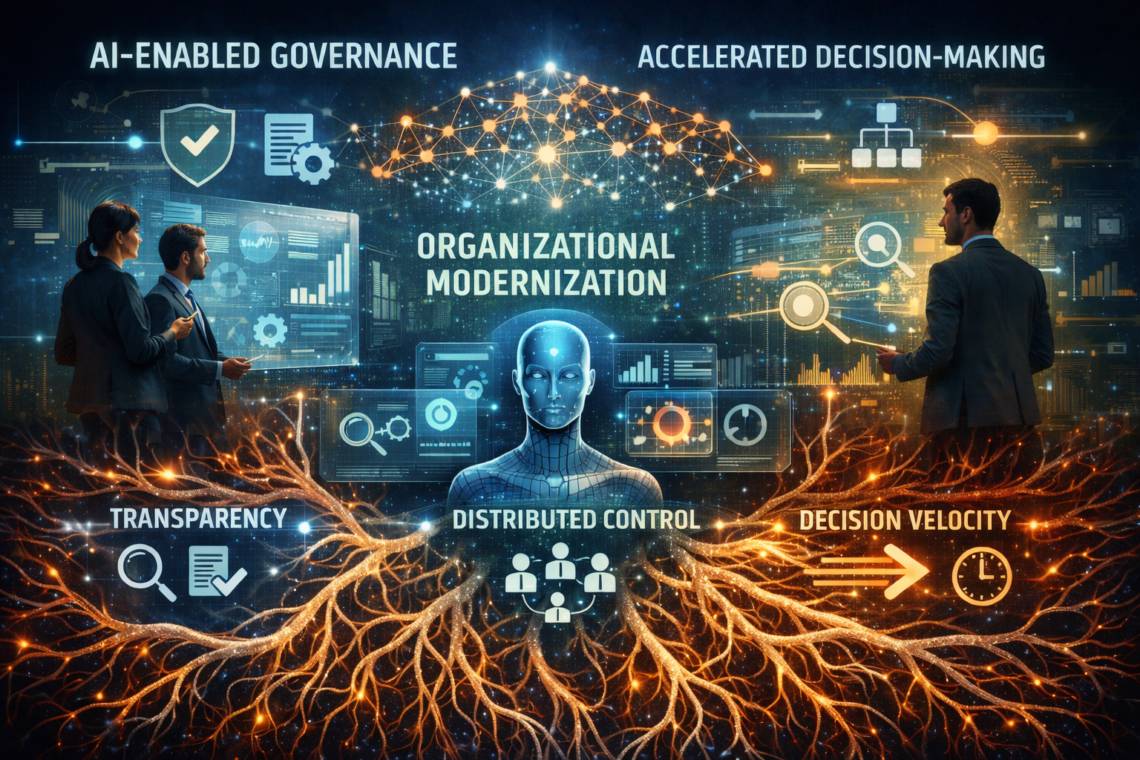
An AI‑Enabled Model for Simplified Governance, Accelerated Decision‑Making, and Organizational Modernization
Abstract
The Mycelium framework offers a new approach to digital transformation by utilizing artificial intelligence (AI) not only to automate tasks but also to reshape governance, speed up decision-making, and modernize organizational operating models. This white paper situates Mycelium within the context of established research and thought leadership from Deloitte, Gartner, and Harvard, highlighting a strong conceptual alignment around adaptive governance, reduced bureaucratic friction, decision velocity, and comprehensive transparency and traceability. The analysis demonstrates that Mycelium effectively synthesizes and applies these perspectives into a cohesive framework tailored for complex, AI-driven organizations.
1. Introduction
As AI becomes integrated into enterprise operations, organizations are realizing that automation by itself does not lead to true transformation. Deloitte highlights the need for AI governance to evolve from being merely a compliance function to a strategic capability that drives innovation and enhances decision-making quality. Likewise, Gartner views AI governance as crucial for achieving quicker time-to-value and improving effective decision-making within enterprises.
Harvard Business Review (HBR) research further demonstrates that many AI initiatives fail not because of technological limitations, but due to organizational inertia, bureaucratic decision processes, and misaligned governance structures. These insights motivate the Mycelium framework’s core premise: governance itself must be redesigned for an AI‑enabled world.
The Mycelium framework conceptualizes organizations as living, distributed systems, where AI augments human judgment, governance is embedded into operational flows, and decision authority is aligned with proximity to information rather than hierarchical position.
2. Related Research and Thought Leadership
2.1 Deloitte: Dynamic and Trustworthy AI Governance
Deloitte’s research reframes governance as an enabler rather than a constraint. Its work on dynamic AI governance argues for governance systems that evolve alongside technology and regulation, integrating human oversight with adaptive controls. This approach aligns closely with the Mycelium metaphor of distributed, responsive structures.
In Trustworthy AI in Practice, Deloitte stresses that trust emerges from end‑to‑end governance across the AI lifecycle, combining clear roles, accountability, education, and continuous monitoring. Mycelium extends this logic by embedding these controls directly into decision workflows rather than treating them as post‑hoc compliance activities.
Deloitte’s AI Governance Roadmap further emphasizes clear decision rights and proportionate oversight, reinforcing the need to reduce centralized bottlenecks while preserving accountability — an explicit design goal of the Mycelium framework.
2.2 Gartner: AI Governance Operating Models and Decision Velocity
Gartner’s AI governance research focuses on operating models, not policies alone. Governance is positioned as a mechanism to balance risk and value creation, enabling faster deployment of AI while maintaining trust, transparency, and oversight.
Gartner’s analysis of data and analytics governance highlights the importance of embedded capabilities such as lineage, observability, and policy enforcement — features that allow non‑technical teams to participate in governed decision‑making. These ideas directly support Mycelium’s emphasis on transparency and distributed intelligence.
Looking forward, Gartner predicts that AI agents will augment or automate a significant proportion of enterprise decisions within the next few years. This shift strengthens the case for Mycelium’s focus on lightweight, adaptive governance structures that can operate at machine speed without reverting to bureaucratic control.
2.3 Harvard: Organizational Redesign, Transparency, and Accountability
Harvard Business Review consistently finds that AI initiatives succeed only when organizational structures and governance models are redesigned to support new decision logics. In Overcoming the Organizational Barriers to AI Adoption, HBR identifies bureaucracy, rigid workflows, and internal politics as primary inhibitors of AI value realization.
In Match Your AI Strategy to Your Organization’s Reality, HBR further argues that AI must be matched with compatible operating models; otherwise, even technically successful pilots fail to scale. These findings strongly reinforce the Mycelium framework’s assertion that organizational design — not technology alone — is the limiting factor.
Harvard Business School research on AI governance also highlights the importance of transparency and accountability to counter black‑box decision‑making. Mycelium operationalizes these principles through built‑in traceability and explainability across decision pathways.
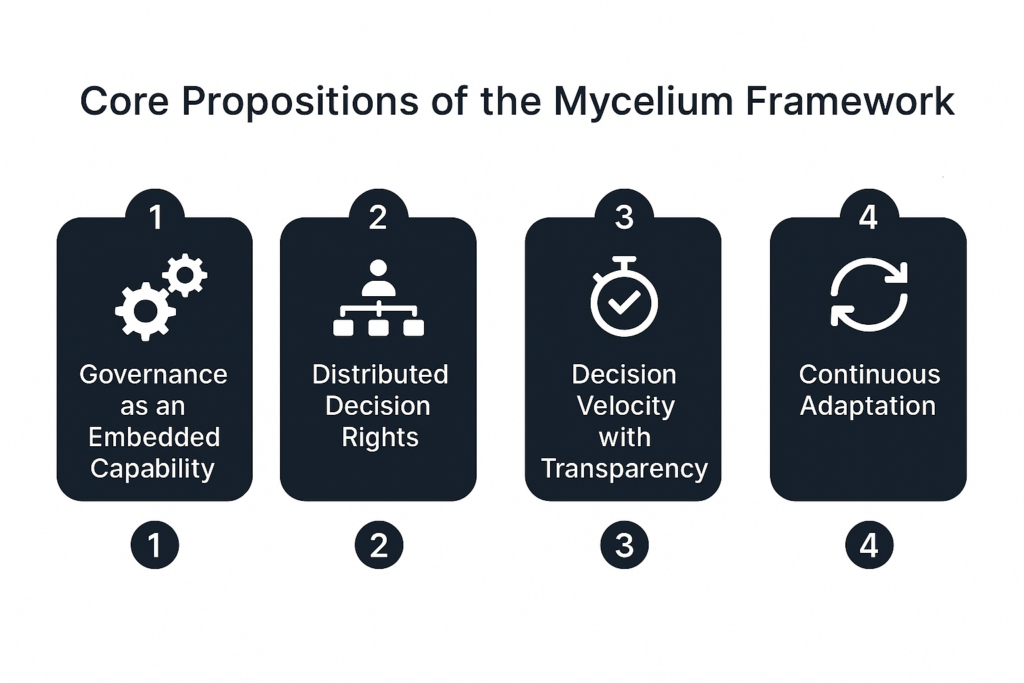
3. Core Propositions of the Mycelium Framework
3.1 Governance as an Embedded Capability
Governance should be integrated into everyday decision‑making, not centralized in slow approval committees. Mycelium embeds controls, traceability, and oversight directly into workflows, enabling speed without sacrificing accountability.
3.2 Distributed Decision Rights
Decision authority is distributed to the organizational edges where information is generated, supported by clear decision rights and risk‑tiered governance. This reduces bureaucratic friction while maintaining alignment with enterprise objectives.
3.3 Decision Velocity with Transparency
Mycelium prioritizes decision velocity while ensuring transparency through lineage, logging, and explainability. This design supports AI‑augmented decision flows anticipated by Gartner and addresses accountability concerns raised by Harvard researchers.
3.4 Continuous Adaptation
Governance is treated as a living system, continuously adapting through feedback loops, audits, and learning mechanisms as technologies, regulations, and organizational contexts evolve.
4. Alignment with Established Frameworks
- Deloitte: Mycelium operationalizes dynamic and trustworthy AI governance by embedding oversight into operational systems rather than external controls.
- Gartner: Mycelium aligns with AI governance operating models focused on decision velocity, time‑to‑value, and enterprise‑wide participation.
- Harvard: Mycelium directly addresses the organizational and governance redesign challenges identified as prerequisites for AI success.
5. Implementation Implications
Organizations adopting the Mycelium framework should:
- Define explicit decision rights and risk tiers for AI‑enabled decisions
- Embed observability, lineage, and explainability into decision systems
- Replace static policies with adaptive governance routines
- Align incentives and performance measures with distributed decision‑making
6. Conclusion
Research from Deloitte, Gartner, and Harvard converges on a central insight: AI demands new forms of governance that are adaptive, embedded, transparent, and decision‑centric. The Mycelium framework synthesizes these insights into a coherent model that reduces bureaucratic friction, unlocks team potential, and enables organizations to scale AI responsibly. As AI increasingly shapes enterprise decisions, Mycelium provides a practical and conceptually grounded approach to modern governance.
References
Harvard Business School, Institute for Business in Global Society. Transparency and Accountability Are Crucial to AI Governance.
https://www.hbs.edu/bigs/marc-rotenberg-artificial-intelligence
Deloitte. Dynamic AI Governance: A Recipe for Crafting Trustworthy AI.
https://www.deloitte.com/us/en/insights/industry/government-public-sector-services/static-to-dynamic-ai-governance.html
Deloitte. Trustworthy AI in Practice.
https://www.deloitte.com/us/en/what-we-do/capabilities/applied-artificial-intelligence/articles/trustworthy-ai-governance-in-practice.html
Deloitte / WSJ CIO Journal. From Compliance to Catalyst: How Strong Governance Can Fuel AI Innovation.
https://deloitte.wsj.com/cio/from-compliance-to-catalyst-how-strong-governance-can-fuel-ai-innovation-2da1f36d
Deloitte (via Harvard Law School Forum). Strategic Governance of AI: A Roadmap for the Future.
https://corpgov.law.harvard.edu/2025/04/24/strategic-governance-of-ai-a-roadmap-for-the-future/
Gartner. How to Design an Effective AI Governance Operating Model.
https://www.gartner.com/en/documents/5577627
Gartner (reported by Technology Magazine). AI Agents Will Drive Half of Decisions by 2027.
https://technologymagazine.com/articles/gartner-ai-agents-will-drive-half-of-decisions-by-2027
Harvard Business Review. Overcoming the Organizational Barriers to AI Adoption.
https://hbr.org/2025/11/overcoming-the-organizational-barriers-to-ai-adoption
Harvard Business Review. Match Your AI Strategy to Your Organization’s Reality.
https://hbr.org/2026/01/match-your-ai-strategy-to-your-organizations-reality

