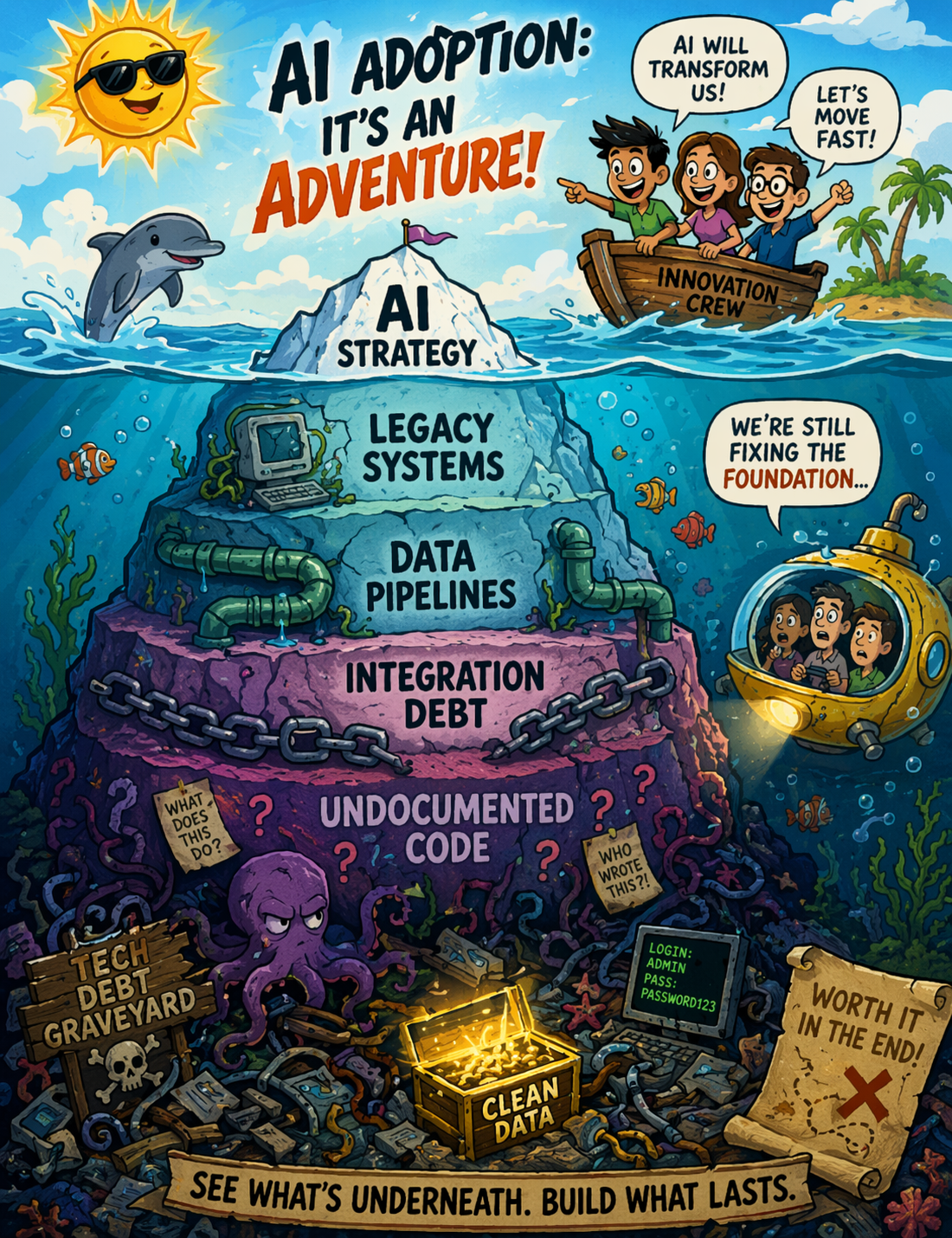
Executives are racing to implement an AI strategy. Engineers are still fixing the foundation. The distance between those two boats may determine whether your organization ever truly transforms.
The illustration appears straightforward at first glance: a mountain peak labeled “AI Strategy” rises above the waterline, shining in the sunlight. A group of enthusiastic executives on a boat gestures toward it, enthusiastically declaring, “AI will transform us!” and “Let’s move quickly!” However, below the surface lies a very different reality. A large, submerged mass reveals legacy systems, data pipelines, and integration challenges. At the very bottom, in a raw, anxious red, is undocumented code filled with question marks, explored by a small submarine crew still attempting to map what lies beneath.
The caption reads: They see the tip. You see what’s underneath.
This image has resonated across LinkedIn feeds, engineering Slack channels, and CTO presentations because it captures something profoundly true about the current state of enterprise AI adoption. The gap between AI ambition and AI readiness is not a gap of imagination or budget; it is a gap of infrastructure, literacy, and debt.
The four layers of the iceberg
At the surface — AI strategy
Visible, exciting, funded. This is where board decks live: GPT integrations, AI-powered products, and machine learning dashboards. It attracts headlines and investment. It is also the thinnest layer of the entire stack.
Layer 1 — Legacy systems
Most mid-to-large enterprises run on systems that predate modern APIs, cloud architecture, and even the internet as we know it. SAP deployments from the 2000s. ERPs that communicate through flat files. Core banking platforms written in COBOL. AI cannot “plug into” these systems without significant — often painful — middleware engineering.
Layer 2 — Data pipelines
AI models are only as good as the data fed to them. But in most organizations, data is fragmented across dozens of systems, inconsistently labeled, poorly governed, and riddled with duplication. Building reliable pipelines that clean, transform, and deliver data in real time is a multi-year infrastructure project, not an afternoon of prompt engineering.
Layer 3 — Integration debt
Every shortcut taken to connect systems — every point-to-point API hack, every webhook duct-taped to a database trigger accumulates as integration debt. Over the years, this becomes a fragile web where changing one thing breaks three others. Dropping an AI system into this environment doesn’t accelerate the business; it adds another node to an already unstable network.
Layer 4 — Undocumented code
The deepest, most dangerous layer. Critical business logic written by engineers who left years ago, with no tests, no documentation, and no clear owner. When AI systems need to interact with these components or when infrastructure must be refactored to support AI teams discover entire ecosystems of code that no one fully understands anymore.
“Moving fast on AI strategy while the foundation is still broken doesn’t accelerate transformation; it accelerates the discovery of how broken things actually are.”
Two boats, two realities
The most poignant element of the illustration is the second boat. While leadership rows enthusiastically toward the future, a quieter group bobs nearby, looking tired: “We’re still fixing the foundation…” They are not opposed to AI. They are not resistant to change. They are simply aware of something their executives may not be: the iceberg.
This is the organizational tension at the heart of most failed AI initiatives. Engineering and IT teams understand the depth of the problem. They have spent years inside the submarine at the bottom of the image, charting undocumented code and patching brittle integrations. When leadership announces an aggressive AI timeline, these teams don’t see opportunity first; they see the cost of the hidden work that must happen before any of those timelines are realistic.
The disconnect is not a communication failure in the ordinary sense. It is a visibility failure. The people making strategic bets are not lying or being reckless; they simply cannot see what’s underwater from their position on the boat.
What actually enables AI transformation
The organizations successfully implementing AI at scale share a common pattern: they invested in the iceberg before they announced the strategy. They modernized data infrastructure years before deploying models. They tackled integration debt as a first-class initiative, not a background cleanup task. They documented systems and established governance before adding AI as a consumer of that infrastructure.
This is unglamorous work. It doesn’t get blog posts or press releases. But it is the work that determines whether the AI strategy at the tip of the iceberg is floating on a solid mass or drifting on nothing.
The practical implication for leaders is this: before asking “how do we adopt AI?” ask “do we have the foundation for AI to work on?” Audit your data pipelines. Inventory your integration debt. Ask your engineers what lives in the undocumented layers. Let them show you the submarine view.
The takeaway
The iceberg isn’t a reason not to pursue AI; it’s a reason to pursue the right things first. Slowing down to fix the foundation is not the opposite of moving fast. It is, ultimately, the only way to move fast at all. The executives in the first boat are right that AI can transform their organizations. They just need to listen to the people who can see what’s under the water.
The article breaks down the iceberg metaphor layer by layer, from the gleaming AI strategy visible above the waterline, down through legacy systems, data pipelines, integration debt, and the murky depths of undocumented code. The central tension the image captures is the two-boat problem: leadership rowing eagerly toward transformation while their engineers quietly say, “We’re still fixing the foundation.”
The core argument is that AI readiness is an infrastructure problem before it’s a strategy problem, and the organizations winning at AI adoption are the ones that invested in the underlying layers before announcing the strategy at the tip.

