Why This Topic Matters?
To understand the importance of this topic, we need to examine the evolution of AI systems. Today, AI is not just limited to generating text or answering questions. Modern AI systems are capable of generating and executing code, accessing files and APIs, invoking tools, and interacting with real infrastructure.
This opens the door to powerful new workflows, but it also introduces new risks. For example, when we run code generated by AI, we may be executing something we didn’t fully review. That can lead to environmental corruption, unexpected changes to the system, or even exposure of credentials.
There is also a financial aspect. AI workloads and cloud resources can scale quickly, and without proper controls, costs can increase faster than expected. So while these capabilities are very powerful, they require us to rethink how we develop and run applications, especially during experimentation.
The Challenge
The Challenge of Modern AI Experimentation
Let’s examine what usually happens when teams begin experimenting with AI workloads.
Initially, the workflow is straightforward. Teams install dependencies locally, run scripts, sometimes generated by AI test quickly, and iterate on experiments. This method is fast and convenient, which is why it is so prevalent.
However, over time, this approach leads to several challenges.
First, reproducibility becomes difficult. As dependencies change and environments evolve, it becomes challenging to run the same experiment again or share it with others.
Second, environment drift occurs. Each installation or update alters the local machine, and eventually, the environment no longer aligns with the application’s original requirements.
There are also security risks, especially when running generated code or scripts that interact with files, networks, or sensitive credentials.
Finally, when it’s time to deploy to production, the disparity between the local and production environments can be significant, making deployment more complex and prone to errors.
The issue isn’t the experimentation itself; it’s how we manage the environment in which the experimentation takes place.
Realistic Example
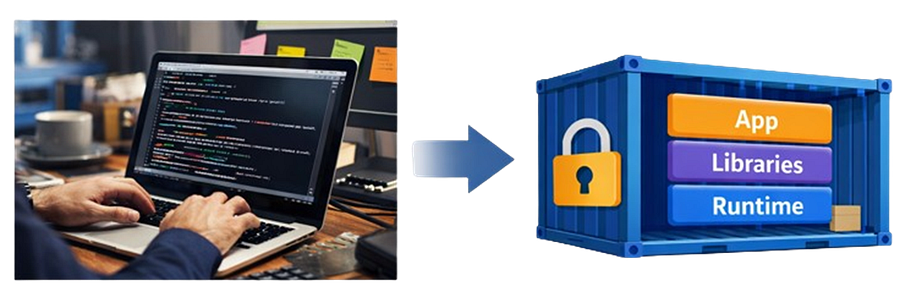
The key idea is simple.
Let’s look at a very realistic scenario that many developers are starting to experience today.
A developer asks an AI assistant to write a script — for example, a Python script to analyze CSV files and generate insights.
The AI generates the code, and the developer runs it. Behind the scenes, the script may install packages, write files locally, access environment variables, or connect to external APIs.
All of this can happen very quickly, and often without the developer fully reviewing every step.
The script might work the first time perfectly, but the local environment has now changed. New dependencies are installed, files may be modified, and configuration may be altered.
Over time, this leads to inconsistent environments, increased security risks, and experiments that are difficult to reproduce reliably.
This is why controlling the execution environment becomes essential when working with AI-generated or experimental code.
A Better Approach
There are a few key principles that help us build AI systems more securely and reliably.
The first is isolation. We want workloads to run in environments that are separated from the host system so that unexpected behavior doesn’t affect other applications or data.
The second principle is ephemeral execution. Experimental environments should be temporary and easy to discard, so we can start from a clean state whenever needed.
The third is reproducibility. We need to ensure that experiments can be run again with the same results, whether on another machine or in the cloud.
And finally, controlled access. Applications should interact with resources securely and predictably, rather than relying on implicit local configurations.
Containers support all of these principles. They create clear execution boundaries, ensure dependency consistency, and make workloads portable across environments from local machines to the cloud.
End-to-End Lifecycle

This diagram summarizes the journey we’re going to follow in this session.
We start locally, where experimentation usually happens. This is where developers test ideas, run scripts, and iterate quickly. To make this safer, we use isolated environments so that experiments don’t impact the host system.
The next step is to package the application into a Docker image. This image becomes a portable artifact that contains the application, its runtime, and its dependencies.
Once the image is built, it can be pushed to a container registry. The registry acts as a central repository, making the image available to other environments, including the cloud.
From there, we deploy the container to Azure Container Apps, which provides a managed runtime, scaling, and networking without requiring us to manage infrastructure.
Finally, the application can integrate with Azure AI services to consume models and AI capabilities in a secure and scalable way.
The key idea here is continuity: the application remains the same while the environment evolves from local experimentation to cloud execution.
Why This Topic Matters?
To understand the importance of this topic, we need to examine the evolution of AI systems. Today, AI is not just limited to generating text or answering questions. Modern AI systems are capable of generating and executing code, accessing files and APIs, invoking tools, and interacting with real infrastructure.
This opens the door to powerful new workflows, but it also introduces new risks. For example, when we run code generated by AI, we may be executing something we didn’t fully review. That can lead to environmental corruption, unexpected changes to the system, or even exposure of credentials.
There is also a financial aspect. AI workloads and cloud resources can scale quickly, and without proper controls, costs can increase faster than expected. So while these capabilities are very powerful, they require us to rethink how we develop and run applications, especially during experimentation.

