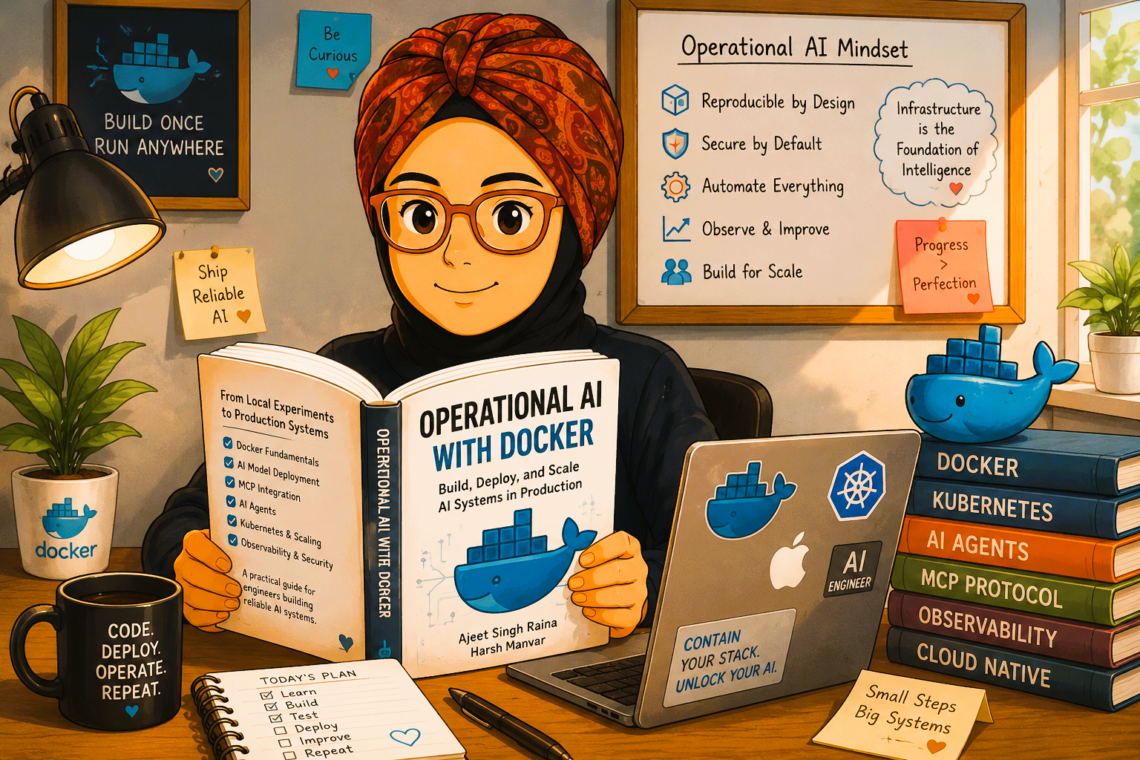
In today’s rapidly evolving AI landscape, most conversations revolve around models, benchmarks, prompt engineering, and new frameworks. But behind every successful AI system lies something far more important and often overlooked: infrastructure.
That is exactly where Operational AI with Docker by Ajeet Singh Raina and Harsh Manvar makes a remarkable impact.
This is not simply a Docker book, nor is it just another AI engineering guide. It is a deeply practical, highly relevant, and forward-looking handbook on how modern AI systems should actually be deployed, operated, scaled, secured, and maintained in production environments.
From the very first pages, the book establishes a clear and compelling purpose: solving the operational challenges that arise when AI projects move beyond experimentation into real-world systems. The authors identify a critical gap in the industry: many engineers know how to train or run models, but far fewer understand how to operationalize them reliably at scale.
What makes this book exceptional is how effectively it bridges that gap.
A Strong Foundation Built on Real Engineering Principles
One of the book’s greatest strengths is its portrayal of Docker as more than just a containerization platform. The authors describe Docker as a “runtime contract”: a reproducible, portable, and operationally stable environment for AI systems. This concept serves as the philosophical backbone of the book.
Instead of viewing containers as abstract tools for DevOps, the authors explain the significance of reproducibility in AI. They highlight the following issues that AI engineers encounter regularly:
- Dependency drift
- Environment mismatches
- Inconsistent GPU setups
- Different operating systems
- Broken CI pipelines
- Deployment inconsistencies
The book addresses these real challenges directly, providing clarity and precision in its explanations.
A Rare Balance Between Accessibility and Technical Depth
One aspect I truly admired about this book is its approachability, even as it delves into highly advanced topics. Many technical books struggle in one of two ways: they are either beginner-friendly but lack depth, or they contain impressive technical content that is difficult to follow. However, “Operational AI with Docker” successfully avoids both pitfalls.
The authors explain complex infrastructure concepts in a way that feels intuitive and rooted in real workflows. Whether they are discussing Docker layer caching, GPU acceleration, Kubernetes autoscaling, or multi-agent orchestration, the explanations remain practical and easy to understand.
The pacing of the book is excellent as well. It unfolds naturally through the following progression:
1. Docker Fundamentals
2. AI Model Management
3. Docker Model Runner
4. Docker Offload
5. Kubernetes for ML Workloads
6. MCP Integration
7. Autonomous AI Agents
8. Multi-Model and Multi-Agent Systems
9. Advanced Orchestration and Sandboxing
This structured progression allows readers to feel as though they are building a complete operational AI stack step by step, rather than simply reading disconnected technical chapters.
Operational Realism Sets This Book Apart
What truly distinguishes this book from many other resources on AI infrastructure is its realism. The authors consistently address the operational challenges that engineers face in real life, including:
- Scaling workloads
- Monitoring systems
- Managing secrets
- Isolating agents
- Routing requests
- Securing execution environments
- Handling distributed communication
- Orchestrating services reliably
Rather than providing idealized examples, the book treats AI infrastructure as a dynamic engineering system that comes with trade-offs, limitations, and operational risks. This realistic approach lends the book considerable credibility.
Additionally, the authors make an important contribution that many technical writers overlook: they clarify when certain technologies should not be used. For instance, the chapters on Kubernetes thoughtfully discuss when it is truly beneficial to use Kubernetes and when it may add unnecessary complexity. This balanced perspective makes their advice feel mature and trustworthy.
Excellent Coverage of Modern AI Infrastructure
The sections on Docker Model Runner and MCP integration are among the most engaging parts of the book, as they illustrate how AI tools are evolving beyond simple inference APIs.
The discussions on the following topics are particularly contemporary and relevant to today’s AI ecosystem:
- OCI model artifacts
- Quantization
- Local inference
- Secure tool access
- Protocol-based integrations
- Model lifecycle management
The chapters on Kubernetes are equally impressive. Often, Kubernetes is introduced in an overly abstract or intimidating manner, but this book effectively connects Kubernetes concepts to the realities of machine learning (ML) deployment. It covers important aspects such as:
- Model serving
- Persistent storage
- Autoscaling
- Health probes
- Resource management
- Inference scalability
As a result, the concepts presented feel practical rather than theoretical.
The chapters on AI agents are particularly innovative and forward-thinking.
The later sections that focus on autonomous AI agents and multi-agent architectures are arguably the most compelling parts of the book. Rather than viewing AI agents as mere hype or abstract concepts, the authors present them as operational systems that require:
- Isolation boundaries
- Orchestration layers
- Communication protocols
- Observability
- Scaling strategies
- Security controls
This perspective is incredibly valuable. The chapters discussing:
- Agent controllers
- Redis-based communication
- Service discovery
- Multi-agent coordination
- Docker sandboxes
- Kubernetes-native orchestration
feel less like experimental prototypes and more like a blueprint for the future of production AI systems. At this point, the book transcends a simple Docker tutorial, evolving into a vision for operational AI engineering as a legitimate discipline.
Strong Focus on Security and Reliability
One of the notable strengths of this book is its emphasis on security. In modern AI systems, particularly autonomous agents, operational safety is becoming as crucial as intelligence. The authors acknowledge this importance and dedicate significant attention to various aspects, including:
- Container isolation
- Sandboxed execution
- Secret management
- Network policies
- Secure orchestration
- Controlled access boundaries
This strong focus on security gives the book a responsible, production-oriented feel rather than a purely experimental one.
Additionally, the sections on observability are excellent, covering essential tools and strategies such as:
- Prometheus
- Grafana
- Jaeger tracing
- Structured logging
- Monitoring strategies for AI workloads
These operational concerns are often overlooked in other AI books, yet they are vital for implementing real-world systems.
Engaging Writing Style that Captivates Readers
Despite the technical depth of the content, the writing remains exceptionally readable. The tone is confident, practical, and educational, avoiding an overly academic approach. The authors demonstrate a clear understanding of both the technology and the effective methods of teaching it.
Their expertise in Docker, Kubernetes, DevOps, and cloud-native engineering is evident throughout the book, particularly in the architectural guidance, troubleshooting techniques, workflow design, and deployment patterns they recommend. The book is written by engineers who have addressed these issues in real-world environments rather than merely studying them in theory.
Final Thoughts
Very few technical books can be described as practical, educational, production-oriented, beginner-friendly, technically deep, and forward-looking all at once. *Operational AI with Docker* succeeds in achieving all these aspects.
This book goes beyond just containers or AI; it focuses on building reliable, scalable, secure, and operationally mature AI systems for the real world.
Targeting:
- DevOps engineers
- Machine Learning (ML) engineers
- Platform engineers
- Backend developers
- Site Reliability Engineers (SREs)
- Cloud-native practitioners
- AI infrastructure teams
This book serves as an exceptional resource and stands out as one of the most relevant AI infrastructure books available today.
By the end, it becomes evident that the authors are not merely teaching Docker workflows; they are offering a comprehensive operational philosophy for modern AI systems. This insight is what truly makes this book special.

