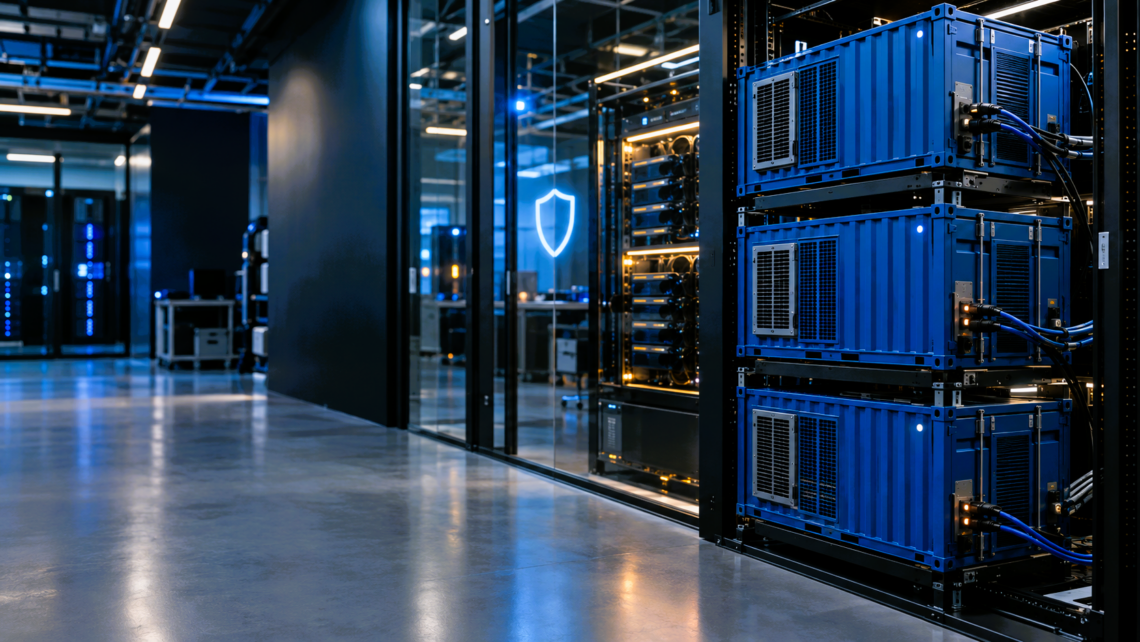
Docker has long been associated with a simple promise: package an application and its dependencies so it runs consistently from a developer’s machine to production. That promise still stands. But its latest developments point to a much broader evolution: Docker is also becoming an execution, isolation, and governance layer for artificial intelligence agents.
This shift matters. Development agents no longer merely suggest a few lines of code. They read repositories, install dependencies, run tests, modify configuration, and use external tools. Giving them that level of access directly on a workstation creates a new attack surface. Docker’s emerging approach is to treat this as an infrastructure challenge, not simply as a permissions setting inside an editor.
Docker Sandboxes: An Execution Boundary for Agents
The most significant development is Docker Sandboxes. The goal is to run coding agents, including Codex, Claude Code, Copilot, Gemini, and Kiro, in an isolated, disposable environment that closely mirrors a real development context.
On macOS and Windows, sandboxes run in dedicated microVMs. This creates a stronger boundary than conventional container isolation: an agent can install tools, run services, and build Docker images without having unrestricted access to the host machine. Network access can also be constrained with allow and deny lists. Docker is therefore emphasizing a critical principle: give agents autonomy, but within a technically enforced perimeter.
September 2026 updates reinforce that direction: shared agent skills are read-only by default; agents can run without mounting a host directory; reproducible environments can be defined in an sbxenv.yaml file; secrets can be resolved from external sources; and sandbox kits can be signed with Sigstore. These are not merely convenience features. They address the traceability, reuse, and control requirements that arise when agents move from prototypes to team workflows.
Gordon: An Agent That Understands Docker Context
With Gordon, available in beta in Docker Desktop 4.61 and through docker ai, Docker has introduced an assistant specialized in its own ecosystem. Its value is not limited to conversation: it can understand running containers, images, logs, Dockerfiles, and a project’s configuration.
In practical terms, Gordon can investigate why a container fails, propose a multi-stage Dockerfile, add health checks, help reduce image size, or highlight configuration that needs improvement. Its actions still require approval. This model is especially relevant to teams that want to accelerate development operations without replacing human expertise: the agent prepares, explains, and carries out repetitive tasks, while the engineer retains decision-making authority.
Agent Teams, Not Just One General-Purpose Assistant
Docker is also advancing the idea of agent teams through Docker Agent (previously introduced around cagent). The aim is to distribute a task across specialized roles: requirements analysis, design, development, quality assurance, and remediation. The value is not simply in using more agents, but in maintaining a clear separation of responsibilities and context.
For organizations, this creates a practical path to industrialize AI-assisted development while preserving reproducible execution environments. A team can define roles, permitted tools, resource allocation, and network rules, then reuse that configuration across repositories or use cases. The value does not come from the agent alone; it comes from the architecture that governs its execution.
Security, Software Supply Chain, and Governance: The Foundation Is Becoming Visible
Docker’s evolution goes beyond agents. The company is bringing together capabilities that were often managed separately: hardened images, vulnerability analysis, access controls for MCP tools, and isolated environments. Docker Hardened Images are intended to provide more minimal and secure base images, while associated VEX data can help contextualize vulnerabilities in automated processes. Docker also highlights MCP Catalog, Toolkit, and Gateway capabilities in Docker Desktop, alongside an AI governance console that connects sandbox policies and MCP policies.
For enterprise architecture, the message is clear: securing code or an image is no longer enough. Organizations must also govern what an agent can read, execute, call, and produce at runtime. Identity, secrets, network access, dependencies, and execution evidence are becoming part of the same control model.
Faster Builds Without Changing Established Workflows
Another, quieter but highly practical development concerns Docker Build Cloud. With Buildx 0.37, the cloud driver is now included in the standard Buildx plugin. Teams can connect their builds to Docker Build Cloud without installing a separate client. This makes it easier to adopt shared remote builds, particularly for large, multi-architecture images or frequent team builds.
The right approach is not to move every build to the cloud by default. Instead, identify the builds that create real waiting time or unnecessary local resource consumption, then measure the outcome: build duration, developer wait time, cache reuse, delivery capacity, and cost.
What This Means for IT Teams
Docker’s direction is clear: containers remain a universal application packaging format, while the platform is becoming a foundation for controlled AI execution. For organizations, three actions are especially useful:
- Start with a limited use case, for example, generating and testing a Dockerfile in a sandbox for a non-critical repository.
- Define guardrails before autonomy: keep secrets off the workstation, minimize network access, approve base images, and apply risk-appropriate logging and approval rules.
- Measure value, not only activity: track time saved, defects prevented, environment reproducibility, and time to make a change available.
Docker’s future is therefore not about “adding AI to containers.” It is about providing the framework that lets agents act quickly while remaining observable, constrained, and reversible. That combination of autonomy, isolation, and governance will determine whether AI agents become an industrial capability or another source of operational debt.
